


I met my best friend, Robert, when I was in third grade and he was in fourth—early in the 80s. We didn’t click right away. He came from a wealthy family, and I didn’t. To me, he seemed spoiled, always bragging about the incredible trips he took with his parents. I resented it, and, if I’m honest, I was jealous too.
He didn’t like me much either. Being a year older, and far more popular, he made sure most of the other kids kept their distance from me. He even came up with a nickname—“fat Brat”—though I wasn’t really that fat. It didn’t exactly hurt; I wasn’t bullied in a dramatic sense. I was just… ignored. They didn’t like me, and I didn’t like them. So I kept to myself and tried not to care.
In sixth grade, everything changed. When school started that year, Robert didn’t show up. Rumors spread quickly—some kids even whispered that he had died—but no one knew anything for sure. By the time he finally returned, nine months had passed. And for reasons none of us understood, he walked into my classroom. Even though he’d always had good grades, he was suddenly repeating sixth grade. Our teacher gave only the vaguest explanation: something about how much school he’d missed and “what happened over the summer.” He refused to go into detail, which only made things worse. Half-answers are fertile ground for the wildest rumors.
Robert never spoke about it either. He was quieter than before, almost timid. Given the gossip, that wasn’t surprising, but there was more to it. He looked genuinely frightened, like someone who believed something was still after him. And I’ll admit: the way he acted made me a little scared, too.
Once he was no longer one of the cool kids, Robert changed. He stopped teasing me and became strangely kind. At first, I brushed him off, told him to go annoy someone else. But eventually, I realized I didn’t have any real friends, and maybe he deserved a second chance. Before long, we were inseparable.
He never told me what had happened during those missing months. I asked him once, and he broke down in tears. After that, I didn’t dare bring it up again.
Back then, the news was constantly warning about pedophiles and serial killers lurking behind every corner. With nothing else to go on, I assumed the worst. That he had been kidnapped or abused. It was the only explanation I could imagine for the fear I sometimes saw lingering in the eyes of the boy who used to seem fearless.
As time went on and we spent more afternoons together—playing video games at the arcade, watching every R-rated movie we could sneak past our parents, and soaking in everything the 80s had to offer—I began to notice things about Robert that didn’t seem right.
He’d developed a slight lisp, which hadn’t been there before. And sometimes, when he thought he was alone, I’d hear him muttering angrily to himself. Not just under his breath, but almost like he was arguing with someone: “Shut up. Stop hurting me. Leave me alone.” It was as though he was fighting off something invisible, something buried deep inside his mind.
It scared me, but I tried to be brave and understanding. I assumed it was somehow connected to whatever had happened to him during those nine months he was gone, the terrible thing I was so sure he had lived through. And despite the odd moments that unsettled me, he became my best friend.
Over the years, Robert never once spoke about what happened to him during that vanished summer in the mid-80s. But the trauma lingered, and seemed to grow worse as time passed.
He developed severe OCD. Before entering certain rooms in his house, he had to jump over the threshold three times—or more—until it felt “right.” He would switch a light on and off repeatedly before he could leave it alone. And sometimes, out of nowhere, he couldn’t bring himself to eat the food he’d ordered or watch the movie we’d just bought tickets for. It was as if his mind was constantly battling invisible rules only he understood.
We ended up at the same college near our hometown. I chose psychology as my major—partly because of Robert, I suppose—while he chose biology, focusing specifically on mycology. When I asked him why mushrooms of all things, he dodged the question. But one day, after I gently pushed a bit harder, he finally answered. I had no idea that a simple “Why mycology?” would be the question that changed everything.
What he told me—his voice trembling—was unbelievable. And yet…it explained so much. His sudden fascination with mycology, it turned out, was connected to what had happened that terrible summer after fifth grade. I couldn’t believe he had carried all of this alone for so many years.
“Please… don’t think I’m crazy,” he said quietly. “I mean, I know I’m not well. I know that. Not since that… that f-fucking trip, man.”
As he said it, I saw something I’d never seen before. A mix of sorrow and relief, like he was finally letting himself breathe. We sat there together on the cold floor of his spartan, almost sterile dorm room.
“I was so excited before we left,” Robert said. “My parents were taking me on one of their adventure trips to the Amazon. The actual Amazon, man. I couldn’t believe it. We were going to paddle canoes down the river, hike through the rainforest, just like in the movies. It was going to be the trip of a lifetime…”
He paused, and then suddenly broke down, sobbing into his hands. I rested my arm on his shoulder, waiting until he could breathe again. When he finally spoke, his voice trembled.
“But it all went wrong just a few days after we got to Brazil,” he said. “We joined this tour group with a couple of guides. I thought it was lame. I didn’t want to be herded along like some kid. That wasn’t the adventure I’d imagined.” He wiped his face, frustration flashing through his tears. “So… I did something stupid. I stepped off the trail. Just a little. I thought I’d find something cool to brag about when I got back home. But the jungle… it swallowed me, man. One moment they were right there, and the next—gone. I couldn’t see them. Couldn’t even hear them. It took less than five minutes.” His breathing grew ragged again. “And the sky…” He shook his head. “It looked wrong. Different somehow. I don’t know…”
“You don’t have to keep going if you don’t want to,” I told him, even though every nerve in me was desperate for him to continue.
“I—I want to tell you,” he said, wiping his eyes. “After everything… after you sticking by me all these years, you deserve to know.”
He took a shaky breath.
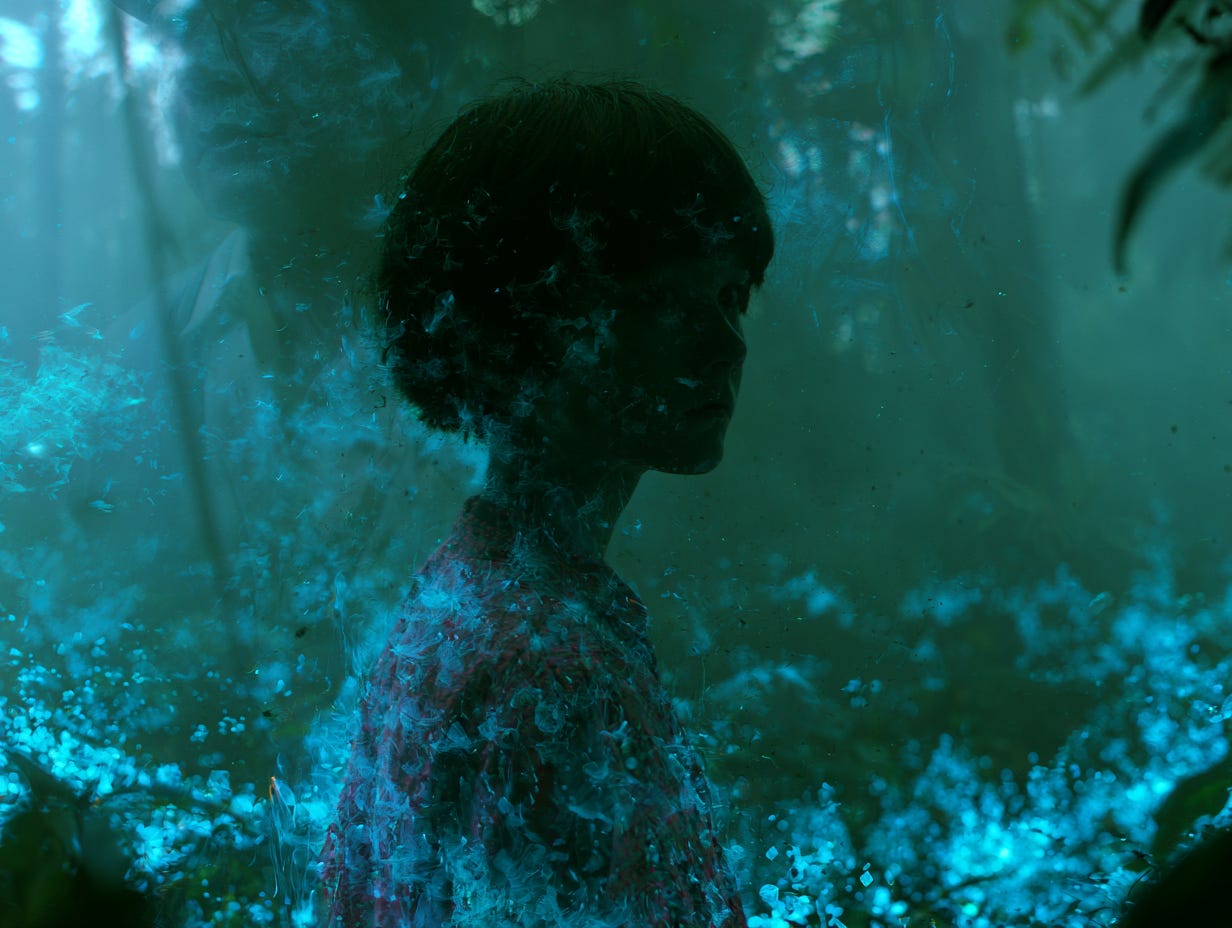
“When I realized I was lost, I panicked. I ran where I thought the group had gone and screamed for my parents as loud as I could, but no one heard me. And then… suddenly, I was standing in this giant crater. At least, that’s what it looked like.” He clenched his fists, fighting for the right words. “It was overgrown with these—these…” His expression twisted. “Fuck you! Shut up! Fuck you!” he shouted, slamming his palm against his forehead. “Sorry,” he gasped. “Sorry. It’s just… this isn’t easy. I’m… not well, you know that.” He took another breath and forced himself onward. “The crater was covered in this blue, luminescent fungus. And there were spores everywhere, floating around me, filling the air. I could feel them in my lungs. Everything got hazy. My body felt heavy. I stumbled back toward the trees… I walked and walked, like hours passed… and then everything went black.” He stared past me, voice barely a whisper. “The next thing I remember, I woke up in a hospital bed. In the States. My parents were there—pale, terrified—and a team of doctors hovering over me.”
I swallowed hard. “What was it? I mean… what do they think happened to you?”
“They told me I’d been in a coma for months,” Robert said. “Some kind of unknown tropical yeast infection had—” he paused, searching for the right word, “—had attached itself to my nervous system. They had no cure. All they could do was monitor me and hope my immune system could handle it.” He gave a hollow laugh. “And eventually, it looked like it did. When I woke up, I seemed healthy. No signs of infection. The doctors said it had disappeared.”
I hesitated. “But you don’t think it really did.”
“No.” His voice hardened. “Because ever since I opened my eyes in that hospital, I’ve felt it. Inside me. Inside my mind.” He leaned forward, eyes wide and unblinking. “No one believes me. They say it’s psychosomatic. A trauma response. But they’re wrong. I can feel that thing in me right now. It’s trying to wear me down, trying to… take over. To possess me.” He swallowed, trembling. “But I’m fighting it. I’ve been fighting every single day since.”
I didn’t believe him, not really. But I didn’t say anything. He was my best friend. Supporting him was the only thing I could do.
“What’s it like?” I asked. “What does it do to you?”
“It’s not like schizophrenia—no voices,” he said quickly. “It’s more like… like it pushes thoughts into my head. Horrible thoughts. Grotesque images of the people I care about.” He shuddered. “And when there aren’t images, there are these… intuitions. A feeling that something awful is about to happen.” He took a breath, then continued in a low voice: “It threatens me. Not with actual words, but with dread. If I don’t follow certain rituals, it makes me feel like something terrible will happen, to me or to someone I love. I know it’s probably irrational, but emotionally? It feels real. It’s torture. Every day.” His eyes glistened. “Sometimes I think… I think it wants me to kill myself. But that doesn’t make sense, right? It would die with me. Wouldn’t it?”
I swallowed, trying to keep my voice steady. “What does it force you to do, Robert?” I asked, worried not just for him, but for everyone around him.
“It doesn’t want me to kill anyone, if that’s what you’re afraid of,” he said. “It’s mostly small things… what I’m allowed to eat, what movies I’m allowed to watch. Sometimes even which girl I should talk to. And it’s never the one I actually like, so I just avoid girls altogether.” He looked down. “I really hate my life.”
“I… I can’t imagine,” I murmured.
He nodded slowly, then a spark of determination flickered behind his exhaustion.
“That’s why I’m studying mycology,” he said. “I’m going to find a cure for myself. That’s my purpose now. I won’t stop. Never. That thing isn’t going to win.”
I didn’t argue with anything he told me. I just listened and tried to be there for him, like always. Every now and then, I suggested he should talk to a psychiatrist, but he wouldn’t hear it. He already had his plan, and nothing was going to change his mind. After that night, we grew even closer. But not long after college, life took us in different directions. I married a wonderful nurse I’d met online and moved to San Francisco to work at a psychiatric clinic. Robert, meanwhile, went all the way to Uppsala, Sweden, to become a lead scientist at the Department of Forest Mycology and Plant Pathology.
I was genuinely impressed. And whenever we talked, he seemed to be doing well. He told me he’d developed mental techniques to keep what he called his “infection” buried deep beneath his consciousness. On the rare occasions he visited us, I noticed he didn’t have that terrified look anymore.
For a while, I truly believed he was getting better.
Then, last year, everything unraveled again.
He called me from Sweden—in the middle of the night for me—and told me he had finally created a cure for his condition. His voice was frantic, barely controlled.
“I’ve done it,” he said. “Just like I promised. My God… I’ve finally done it!”
I sat up, groggy and alarmed. “Done what? Robert, what’s going on?”
My wife woke beside me, confusion turning quickly into concern.
“I’ve developed a cure…”
“A cure? For what?” I asked, though I already knew.
“For my infection!”
I rubbed my face, trying to wake up fully. “Robert, it’s the middle of the night—”
“I need you to come here,” he interrupted. “I can’t tell anyone at the department what I’ve been doing behind their backs, and I need someone to make sure I’m safe when I take the cure. I don’t think there’s any danger, but if my heart stops, you’ll need a defibrillator ready.”
“You… want me to come to Sweden?” I whispered.
My wife grabbed my arm. “No,” she mouthed, eyes wide.
“Robert,” I said carefully, “don’t do anything you might regret.”
“That’s why I need you here,” he insisted. “If you can’t come, I’ll have to do this alone. I’d fly to you instead, but I’m afraid airport security would confiscate the substance. It’s brilliant, what I’ve created. I’ll pay for your tickets. Both of you. You and your wife deserve a vacation anyway. You haven’t taken one in forever!”
“Robert… I don’t know,” I said.
My wife leaned close and whispered harshly, “You do know. Say no.”
I covered the phone with my hand and turned to her. “I know it sounds insane,” I whispered back. “But he’s offering to bring us both. All expenses paid.”
Her expression softened just slightly.
A week later, we were on a flight to Stockholm. Maybe it was reckless… but we genuinely hadn’t had a vacation in ages. And now that it was free, it felt almost foolish to refuse. Or at least, that’s how my wife convinced herself.
I was worried about my friend, more than I admitted to my wife. He trusted no one else the way he trusted me, and I truly believed I was the only person he would turn to for help. What that help would look like, I didn’t yet know, but experience with psychotic patients had taught me what to expect. It would be no different this time, or so I convinced myself.
We landed at Ärna Airport in Uppsala late at night, after a brief stop in Stockholm. Robert was waiting for us outside, standing beside his car under a black umbrella as rain poured from the dark sky. He looked… exhilarated. Not just happy to see us, more like someone on the verge of being freed after years of captivity.
When I shook his hand, it was damp, not from the rain, but from sweat.
“Let me take you to the hotel,” he said, hurrying around the car to open the doors for us.
I hesitated for a moment, unsure if he was in any shape to drive. But Uppsala was quiet at this hour—almost no traffic—so I pushed the worry aside. I did make sure my wife buckled her seatbelt, more firmly than usual. Robert slid into the driver’s seat after us. For a long moment, he just sat there, silent. The only sound was the steady drumming of rain against the roof.
Finally, he spoke.
“I’m really grateful you came all this way,” he said, pulling the car into motion. “I can’t thank you enough. I think we should get this over with quickly. And then—when it’s finally over—we can spend the rest of the week just catching up. How does that sound?”
“You… want to do it now?” I asked, my voice unsteady.
He let out a brief laugh. “No. You need rest first. You’re both jet-lagged. I can see it in your faces.” He paused, eyes fixed on the wet road ahead. “But I was thinking… maybe tomorrow morning?”
He was right, my wife and I were exhausted. I told myself we’d sleep first, and then in the morning I’d try to talk him out of whatever reckless plan he had. But sleep never really came. My mind kept spinning, rehearsing the words I hoped would pull him back to reality.
When morning finally arrived, any plan I had fell apart instantly.
My phone rang. Robert. His voice was shaking so violently that I could hardly make out a single word. It sounded like he was in the middle of a full-blown panic attack.
“Robert, slow down,” I said, sitting upright in bed. “Breathe. Tell me what’s happening.”
“O-okay… just listen,” he said. “This is how we’re going to do this. I trust you, but I know you’ll try to talk me out of it. And you can’t. There’s no other way. It’s this or suicide. No psychiatrist in the world is going to change my mind.”
My heart rate spiked.
“I’ll be waiting for you and your wife at my apartment,” he continued, giving me the address. It was only a few minutes away on foot. “As soon as we hang up, I’m going to ingest the cure. When you get here, I’ll probably be fine. But if not… check my pulse, do everything you can to wake me.”
“Robert—”
“No police,” he snapped. “No one else. If they find out what I’ve been doing at the department, I’ll go to prison. You’d destroy my life. It has to be you. You’re the only person I trust.”
“Please don’t do this,” I pleaded.
“Get dressed and come over. And… thank you. For everything.”
“Robert, wait—!”
But he had already ended the call.
My wife was fully awake by then. We jumped out of bed, got dressed as fast as we could, and ran out of the hotel. On the way to his apartment, I called an ambulance. It was the only responsible choice. His life meant far more to me than his career, and I told myself that once he received proper help, he’d understand. We burst into his apartment without knocking.
Robert was lying on his bed, unconscious. A bluish liquid had leaked from his nose. On the floor beside him was a glass tube, still glistening with traces of a clear fluid. I rushed to his side and checked his pulse.
Nothing.
“Shit, what do I do? What do I do?” I kept repeating, panic rising, until my wife pushed past me and grabbed a pair of defibrillator paddles from the table next to the bed.
I stepped back.
She tore open his shirt, planted the paddles on his chest, and shocked him. Nothing. She shocked him again. Still nothing. A third time.
“Wait!” I cried. “He’s breathing—he’s breathing!”
I pointed at his chest, where it was rising and falling, ever so slightly.
The first responders arrived within minutes. They rushed Robert to the nearest hospital, and my wife and I followed close behind. He remained unconscious for nearly a week. We stayed by his side the whole time, barely sleeping. The police questioned us as well. I told them the truth, but emphasized that if any laws had been broken, his actions were driven by severe psychological distress. I explained everything I knew: the trauma from his trip to the Amazon, his belief in the infection, the years of fear and mental decline.
When he finally woke up, I was standing beside his bed.
“Hey,” I said softly. “How are you feeling?”
He looked at me, tears filling his eyes. Relief and sorrow, tangled together. Then he broke down completely. It was a raw, childlike sobbing, and through it he choked out:
“M-mom… Where’s my mom? I want my mom!”
“Robert,” I said, trying to steady my voice. “It’s me. Brat. You’re in the hospital. We almost lost you. I’ll call your parents right away and tell them you’re safe.”
That’s when he truly looked at me for the first time since waking up. His eyes focused, recognizing me.
“He’s gone,” Robert said. He was smiling now, even as tears kept streaming down his cheeks. And his lisp—gone. “My God… I’m finally free.”
I couldn’t help but smile too. I didn’t think he had cured an actual infection, of course. More likely, whatever he’d taken had worked as a powerful placebo, shattering the grip his trauma had on him. Maybe he had freed himself from his inner demons, in a way.
I reached out to rest a comforting hand on his shoulder, but he flinched away. His expression changed. The fear vanished. The relief vanished. And in a tone as childish and cruel as the one he used back in elementary school, he muttered:
“Don’t fucking touch me… fat Brat.”
I froze. My hand dropped. My face went cold.
My wife stared at me, baffled.
“What’s happening, honey?”
“I… I don’t believe it,” I whispered, stepping back. “I don’t believe it…”
Robert stared at me with the same sharp contempt he’d carried in third grade, before any of this had ever happened.
In the end, he was transferred back to our hometown, where his mother became his caretaker. That day in the hospital was the day I lost my best friend. Since then, I’ve found myself thinking—over and over—about the blue fungus hidden deep in the Amazon, and that strange bluish liquid that leaked from his nose all those years later. What if he really was right about everything… except for one crucial detail?
Thanks for reading. If you enjoyed this story, you can find more of my writing, books, and other projects at www.tobiasmalm.com. You can also support my work on Patreon at patreon.com/tobiasmalm.