


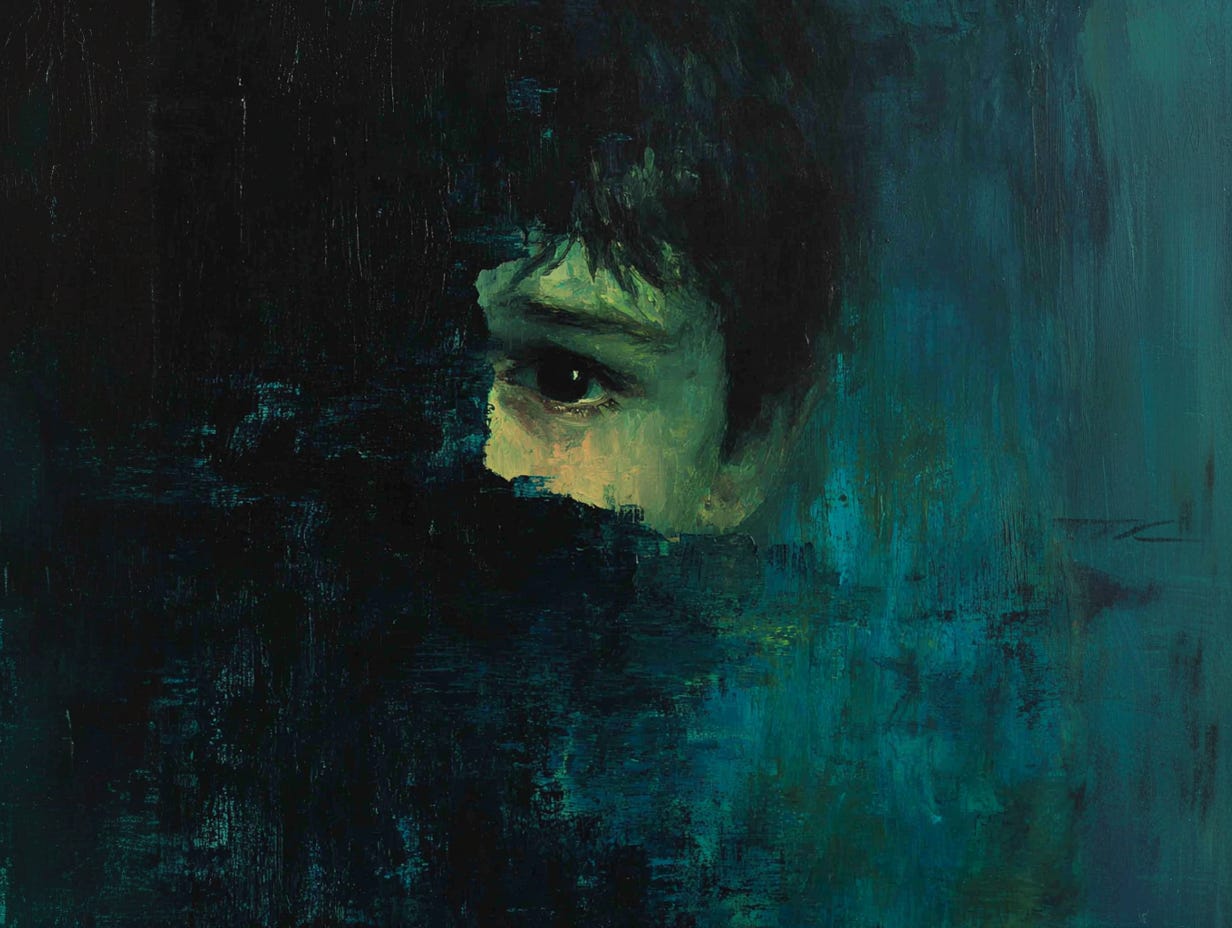
I’m sitting in a café in Stockholm, typing these words on my phone. It isn’t that late, but the darkness has already settled outside, bringing with it the city’s sharp December cold. Once, this month meant happiness; now that feeling is nowhere to be found. My God, the people around me are staring. I must look as if I’ve seen a ghost. Perhaps I actually have. I can’t go home. I don’t know what to do.
It all began at my vocational school, where I’m studying to become an e-learning specialist so that I can finally move on from my cleaning job. The assignment we were given was to write instructions on how to walk from the central station to Stockholm Palace. The purpose was to train us in writing clear, pedagogical directions. To make things easier, I turned to Google Maps. I set the location to the central station, switched to Street View, and took the short trip virtually. Along the way, I paid close attention to buildings, signs, and any other details I could use in my instructions. Until then, nothing seemed out of the ordinary.
Then I saw it: a book. It wasn’t real, though. The thing was animated, clumsily placed on the ground in what looked like a poor attempt at augmented reality. I zoomed in. The cover said “Myst.” That surprised me. I had loved that game as a kid, and my childhood friend and I had spent countless hours trying to finish it. For those too young to know, Myst was an old puzzle game where you explored a deserted island by clicking from place to place, not so different from using Google Street View.
My first thought was that it had to be a clever Easter egg in Google Maps, so of course I clicked on the book’s cover. Instantly, I was transported to the island from the game. I hadn’t seen it since childhood, yet I recognized it right away. Still, something about it felt off. I couldn’t put my finger on it. The feeling was strange, almost unsettling. The best way I can describe it is as bitter nostalgia, like stepping into a forgotten place from your past that has stayed the same, waiting quietly for your return. The sight of it made me think of my childhood friend, Pontus. I wondered what had happened to him and tried to remember the last time we met. I couldn’t. Perhaps his parents had moved away. I thought about reaching out, but then it hit me—I never knew his last name.
I clicked my way around for a while. The sound was off, since I was in class, but that didn’t bother me. The original game had never relied much on audio anyway. When my teacher called for my attention, I shut the laptop and pretended to listen to her. In reality, all I wanted was to get back to that 3D-animated island. By the time school ended, the sun had already slipped below the horizon. I hurried home, curious but also carrying an odd sense of unease that I couldn’t quite explain.
When I got back to my apartment, I opened my laptop almost immediately. The screen showed me Myst Island in Google Maps, with my view fixed on the dock and the looming building that looked like a pair of giant gears. The island was dotted with these odd, mysterious structures. I turned on the sound, and that was when I realized something wasn’t right. In the original game, the audio was simple: water, wind, and a few ambient effects. Occasionally, a piece of music would play, but rarely. Now it was different. What I heard chilled me. There was faint crying. It wasn’t the high-pitched cry of a toddler but clearly that of a child. Uneasy, I clicked through the island. The crying grew fainter the closer I got to the gear building, so I turned back and headed instead toward the library at the island’s center.
The closer I came to the library, the louder the cries grew. It was certainly unsettling, yet I didn’t think it was anything more than a hacker’s trick, so I kept going. When I finally stepped inside, the crying stopped. On the floor was a black book that didn’t belong there. In the original game, books acted as portals to other worlds, but this one was different. The strange thing was that, despite knowing it wasn’t supposed to be there, I still felt a spark of recognition. It was like something pulled from a distant memory, one marked by a vague and bitter sadness.
I clicked on the book to see its title. “Farölk” appeared in gold on the black cover. I didn’t know the word, but it filled me with a strange, primal anxiety that I couldn’t explain. Sweat prickled my forehead, and my heartbeat sped up. I didn’t enter the book; I couldn’t bring myself to. Instead, I clicked the corner of the screen to back away. I turned toward the library door, and there it was—the source of the wailing. I shot upright in pure fright, hands pressed over my mouth. On the screen, at the doorway to the library, stood a boy.
It wasn’t the suddenness of his appearance that frightened me, but the way he looked. I knew that face. Tears welled in my eyes. How could this be happening? The boy before me was Pontus, just as I remembered him. My hand trembled as I clicked to move closer, holding my breath. Yet in the next frame he was farther away, his back to me. I clicked again, and the same thing repeated. It felt like he was walking away, each click pulling him further. I kept clicking, desperate, as Pontus—or whatever he had become—moved toward the dock where I had first appeared on the island.
When I reached the dock, he was gone. Another book lay on the ground with “Home” written on the cover. I clicked it and was instantly transported back to the bridge where I had discovered the first book. Looking around, I spotted the boy again, as though he had been captured inside the photograph, caught mid-step toward the central station. I clicked forward in the direction he seemed to be moving, and in every new frame he appeared, always just ahead of me. Terror gripped me, but beneath it there was another feeling I couldn’t explain. It sat heavy in the core of my being: guilt.
I followed the boy through the city on Google Maps for what felt like more than an hour. Then it struck me: he knew exactly where he was headed. He was only a few blocks from my apartment. Panic shot through me. I hurled the computer to the floor, threw on my clothes as quickly as I could, and ran.
And that leads me to this moment, here in this café. I’m trying to piece together what happened to my friend. We once spent nearly every day together, playing games, until one day—though I can’t remember when—I found myself playing alone. From that day forward, he was gone from my life.
The door chimes rang—wait, the door’s opening—oh my God… no one’s there, no one’s coming in… at least no one I can see—I gotta g—