


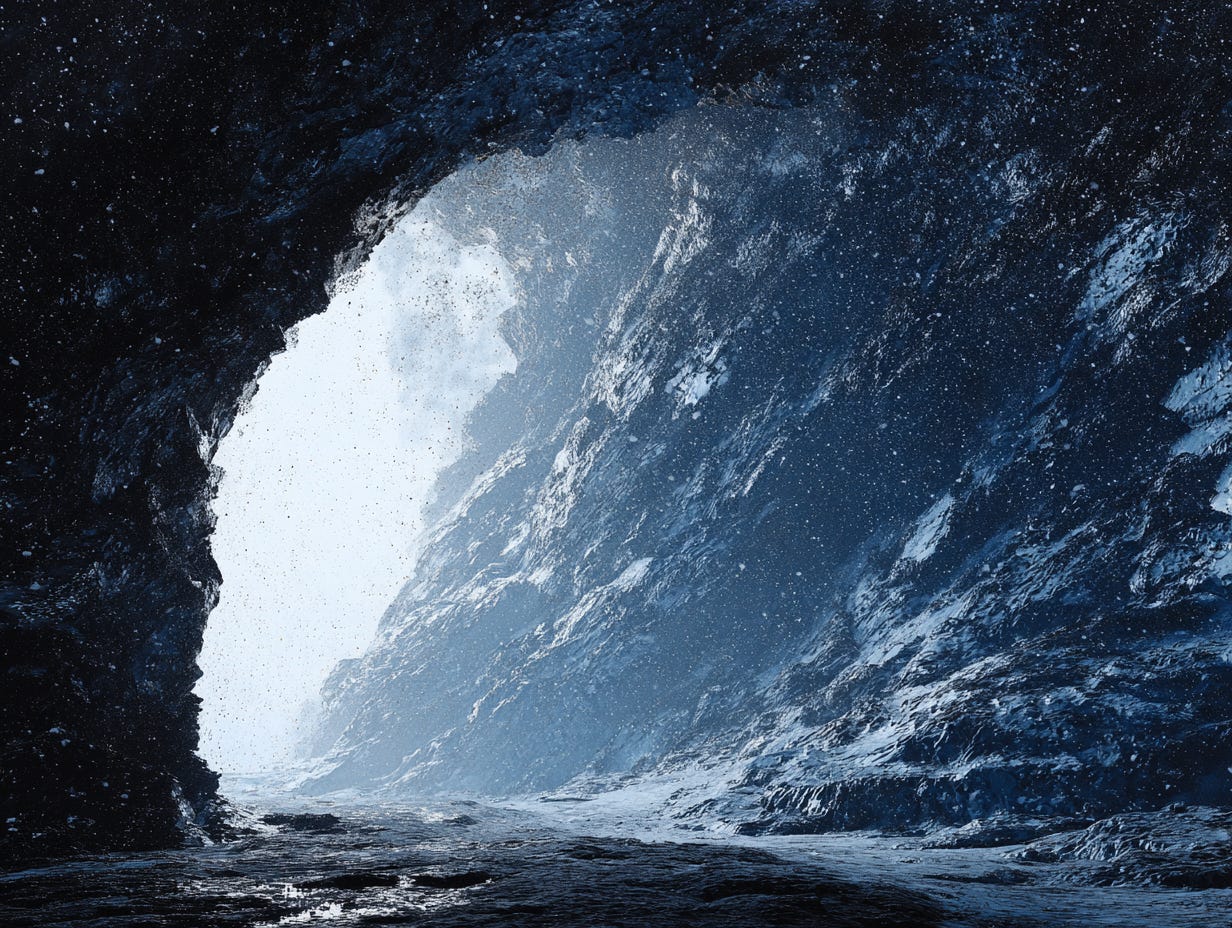
I sat just outside the narrow entrance of the Optymistychna Cave, radio equipment spread out before me, shivering in the biting February air. A faint, intermittent broadcast crackled through my headphones—strange and barely perceptible, as if it were slipping in and out of existence.
Nearby, my close friend, Dr. Nataliya Morozov, paced in tight circles and hugged her arms to her chest in a futile attempt to stay warm. We had stumbled upon the signal entirely by accident while exploring the cave—a vast, partially charted gypsum maze beneath the Ternopil region of western Ukraine—and ever since, we had been obsessed. Every free moment was spent trying to locate its source. We still had no answers. After numerous failed attempts to pick up the signal from anywhere else, one thing remained certain: it was coming from deep inside the cave.
“Let’s start a fire, Oleksandr,” Nataliya muttered through chattering teeth. “It’s so damn cold.”
“It’s back!” I cut her off, leaning forward. “Listen!”
She rushed to my side and crouched beside me. Since the discovery, we had invested in a more advanced receiver capable of picking up even the faintest signals, and it had paid off. The voice breaking through the static was now clearer, though no less baffling. It wasn’t Ukrainian, Russian, or any other language we recognized. The closest resemblance we found was to Warlpiri, an Indigenous Australian language, but after consulting an expert, we learned that despite a few surface similarities, it was not the same.
Our original plan was to assemble a team of specialists and venture into the cave’s deepest, unmapped regions to track down whoever—or whatever—was sending these transmissions. But the Russian invasion changed everything. The country was too unstable, and it was far too dangerous for the two of us to attempt such an expedition alone. For now, all we could do was keep recording the strange voice and study it from afar, hoping its secrets would eventually reveal themselves.
We were both completely absorbed in the mysterious voice when a deafening roar shattered our concentration. A fighter jet tore across the sky above us, the thunderous rumble shaking the earth beneath our feet. We flinched, instinctively ducking as the sound reverberated through our bones.
This region had remained relatively untouched by the war so far, yet the sight of the jet streaking overhead—a trail of white vapor cutting across the gray winter sky—filled us with a cold sense of dread.
Then came the explosion.
A second jet, struck by what must have been a missile or anti-aircraft fire, erupted in flames above us. Shrapnel and debris rained down, sending us scrambling behind the cave entrance for cover. When we dared to look back up, a lone parachute was unfurling against the sky. The pilot was drifting toward the ground.
“Is it one of ours?” I asked, heart pounding.
“No,” Nataliya replied, her voice tight with worry. “We need to pack up. Now.”
I shut off the receiver and shoved everything into my backpack as quickly as my shaking hands allowed. My heart hammered in my chest, adrenaline pushing me into frantic motion. As we prepared to head for the car, the pilot landed—right between us and our only escape route.
He tore off his parachute harness and staggered toward us, his hand already gripping the pistol at his hip.
For a split second, we just stared, frozen by fear and disbelief. Then instinct took over. We turned and sprinted back toward the cave. The military would be hunting him already; he must have known that. And he couldn’t risk being seen, let alone identified. To him, we weren’t potential allies. We were witnesses.
I didn’t dare look back, but I could hear him closing in: boots pounding against the frozen ground, his breathing ragged and furious. We ran faster. It still wasn’t fast enough. We reached the cave entrance and ducked inside, fumbling to switch on our flashlights. The pilot stormed in right after us, gun drawn, the beam of our lights glinting off the metal. His eyes were wild. Terrified, cornered. Whatever slim chance he thought he still had, he was willing to fight for it. We barreled deeper into the cave without a second thought. The tunnels were narrow, uneven, and slick with moisture. We stumbled more than we ran, scraping hands and knees against the jagged gypsum walls as we pushed forward.
Behind us, the pilot shouted harsh, panicked curses that echoed through the chambers and seemed to chase us down the passage. His footsteps were growing louder, closer. We knew we couldn’t outrun him. But we kept going anyway, driven purely by fear and the instinct to survive.
We ran until our lungs burned and our legs threatened to give out. The pilot’s footsteps echoed behind us, closer every second. Just when it felt hopeless, a narrow crack in the cave wall appeared ahead like a final lifeline.
We didn’t hesitate.
We squeezed through, scraping skin and twisting our bodies in ways they were never meant to bend. On the other side, the passage opened into a large chamber. It was dim, but a single shaft of light cut down from a small hole high above. A sliver of sky shone through. Hope surged through us. The world outside was tantalizingly close.
“Can we climb up there?” Nataliya asked, already shrugging off her backpack. “Help me, quick! He’ll be here any second!”
I nodded and crouched down, lacing my fingers together to give her a foothold. Nataliya stepped into my hands and pushed off, reaching desperately for the edge of the opening above. I heaved upward as she scrambled, her boots slipping against the rock.
Behind us, the pilot’s voice echoed through the chamber, shouting for us to stop, swearing, promising he wouldn’t hurt us even as he chased us with a gun. His footsteps were only seconds away. Nataliya finally managed to pull herself through the hole. She leaned back down, extending her arms. I seized her wrists, and she hauled me upward with every ounce of strength she had left.
A gunshot cracked through the cave. The bullet whizzed past our heads, chipping rock and filling the chamber with a sharp metallic ring. The pilot had made it inside. We tumbled out onto the rocky hillside beyond the opening, the cold February wind cutting across our faces like knives.
“We have to keep moving,” I gasped, legs already shaking. “He’s still coming!”
The wind howled around us, flinging snow so thick we could barely see a few feet ahead. We had completely lost our bearings. No sense of direction, no idea where the car was anymore. Turning back toward the cave meant running straight into the pilot, and the shadowy figure forcing his way out of the opening behind us confirmed that wasn’t an option.
We pushed forward blindly through the storm—stumbling, half-sliding—when a looming shape emerged from the swirling white. At first, it felt like a trick of the blizzard, some towering mirage. But as we squinted through the freezing gusts, we realized it was real: a massive metallic tower rising out of the snow. Nothing like this existed here. We knew this area better than most, and yet we had never seen or heard of anything like it.
“What is that?” Nataliya breathed.
We ran toward it—our only hope for shelter or help—boots skidding on the icy ground. As we drew closer, the outlines sharpened. A smaller structure stood at the tower’s base: a building with strange, ornate patterns carved into its walls, the kind of architecture that didn’t belong in Ukraine… or anywhere we recognized.
“What is this place?” I asked as we staggered closer. “This isn’t supposed to—”
Nataliya wasn’t listening. Her eyes were fixed on the top of the tower, wide with awe. “This is it,” she whispered, breathless.
“What?” I urged, glancing over my shoulder. “We need to get inside. Now! We have to call for help.”
She grabbed my arm, her voice trembling with excitement. “Don’t you understand, Oleksandr? It’s… the source.”
A shiver ran through me, colder than the wind. She was right. It did resemble some kind of radio tower, though unlike any design we’d ever seen. And yet we knew this region. We had mapped caves, surveyed nearby structures. Nothing like this should exist here.
Through the swirling snow, the pilot’s silhouette emerged again.
“Inside,” I said, pulling her toward the smaller building at the tower’s base. “Hurry!”
We reached a metal door and yanked the handle, but it refused to budge. Locked. From the inside. Panic clawed up my throat. The pilot was nearly on us, gun raised. Then the ground began to tremble beneath our feet. A low rumble built into a deafening roar, drowning out even the wind. The entire tower seemed to pulse, resonating with a deep vibration that shook the snow loose from its steel frame. Nataliya and I exchanged a terrified glance.
At first, I thought the sound might have triggered an avalanche somewhere up the hill. But before I could finish the thought, something immense emerged from the swirling white. Nataliya clutched my shoulder, eyes wide.
“My God,” she whispered. “Those are mammoths!”
We flattened ourselves against the tower wall as a whole herd thundered past. Massive forms materializing out of the storm, shaggy bodies shaking the earth with every step. Snow sprayed into the air as their tusks carved through the blizzard. The pilot never stood a chance. He stumbled back, dropping his gun, then tried to crawl away, but the creatures were all around him. For a moment he vanished completely into the chaos of hooves and trunks.
When the herd finally disappeared into the storm again, the world fell eerily quiet. Nataliya and I rushed toward where we had last seen the pilot. He lay crumpled in the snow, alive, but badly injured. His arm hung at an unnatural angle, and dark blood soaked through his sleeve. Whatever threat he once posed was gone.
“We have to help him,” I said, breath still shaking. “Let’s get him to the tower.”
“Those were mammoths!” Nataliya gasped, still reeling. “How is that even possible?”
“I don’t know,” I said, forcing myself to focus. “Right now, we have to get him help.”
We dragged the injured pilot toward the building—when a low, guttural growl sliced through the wind. All three of us froze. The pilot pushed himself up just enough to look behind us… and screamed. Two enormous predators emerged from the blizzard, moving with slow, deadly purpose. Their tawny fur rippled beneath layers of frost, and their amber eyes locked straight onto the pilot.
“Cave lions…” Nataliya’s voice trembled. “That’s what the mammoths were running from.” She seized the pilot by his collar. “Your gun!” she shouted. “Do you still have your gun?”
The pilot’s face contorted with fear. He gave a small, frantic shake of his head.
“N-no,” he stammered.
One of the lions suddenly lunged, jaws gaping as it barreled toward us. I braced for the impact—sure this was the end—but before it could reach us, the door of the building burst open. A tall man stepped out, dressed in a stark white uniform and a green turban. Without a word, he fired two shots into the air. The cracks echoed through the storm. The lions skidded to a halt, hesitated for a heartbeat—as though weighing the threat—then pivoted and vanished back into the blizzard. The man lowered his rifle just enough to switch his aim… directly to us.
When his face came into full view, instinctively I recoiled. I had never seen features like his on a living person. His brow ridge was heavy and pronounced; his forehead sloped sharply back. His nose was broad, his eyes deep-set beneath shadowing lids. Strong jaw, wide mouth, large white teeth. It was a face that didn’t belong in our time. And something about him struck me with a fear I couldn’t name, as if my brain recognized a threat far more ancient than the cave lions.
He spoke the same language we had heard over the receiver outside the cave, confirmation that this place was truly the source of the mysterious signals. We lifted our hands slowly. The pilot struggled to follow suit; his broken arm hung limp at his side, but he still surrendered. The man in the turban looked as startled by our presence as we were by his. He barked something toward the doorway behind him. A woman in the same white uniform appeared, scanned us with wide, wary eyes, and then darted back inside.
“What on earth is happening?” I whispered. “Who are these people?”
“It’s impossible…” Nataliya murmured. “The animals… and now him.” Her voice dropped to a terrified hush. “Oleksandr, this man isn’t even—”
Her theory was cut off by the man shouting again, sharp and commanding. Two more figures rushed out beside him, rifles leveled at us. The cold was eating through my clothes; my teeth chattered so hard my jaw ached.
Panicking, the pilot cried out in Russian—pleading not to be shot—unaware that these people didn’t understand him. Or Ukrainian. Or any language we knew.
“Quiet,” Nataliya hissed, gripping his coat to shut him up.
The wind howled around us, and for a moment, all I could hear was the thundering of my own heartbeat and the steady click of rifle safeties being disengaged.
“What’s happening?” the pilot whispered hoarsely. “Who are they?”
“Denisovans,” Nataliya murmured. “Now keep quiet.”
I stared at her, stunned. “Denisovans? They went extinct tens of thousands of years ago.”
“I know,” she whispered back, eyes locked on the armed figures, “just like the animals.”
The man in the turban stepped forward, rifle still aimed squarely at our faces. He searched us briskly, stripping away our belongings, then motioned for us to move. We exchanged terrified looks—and obeyed.
They guided us inside, into what turned out to be a large underground complex beneath the tower. The walls were covered in elaborate carvings and mosaics. Strange battle scenes filled with creatures I couldn’t identify. Tables were cluttered with unfamiliar tools and stacks of papers, and rows of bulky machines hummed softly, like outdated computers from decades past.
We were escorted to a small room where the woman in the white uniform waited. She pointed at a bench for us to sit on, then exited quickly and locked the heavy door behind her. The pilot lurched to his feet, pounding on the metal with his good arm and shouting to be released, panic rising in his voice with every blow.
“Calm down!” Nataliya snapped. “Do you really think that’s going to help?”
I slid down the wall until I was sitting on the cold floor, trying to steady my breathing. “Nataliya… I’m struggling to make sense of any of this. It feels like we’ve stepped into someone else’s nightmare. How did we end up here?”
She moved around the room, studying the unfamiliar equipment with intense focus. “I don’t understand it either,” she said. “But based on everything we’ve seen, I think we’ve crossed into a world where history took a different path. In our world, we—Homo sapiens—outcompeted Neanderthals and Denisovans, and we hunted most megafauna to extinction.” She paused, turning to look at me. “Here, it’s like… humanity never took over. Our footprint was never made.”
She reached into a collection of rolled documents and pulled one free. “Look at this!” She spread out a large black-and-white map on a nearby table. I stood and leaned beside her.
“This map isn’t oriented the way ours are,” she said, tracing the shapes with her finger. “The continents are recognizable, but Asia is centered, almost like the standard Mercator projection never became a convention. Just goes to show how arbitrary our notion of the world is.”
“There aren’t any borders,” I noted, scanning the surface. “No countries at all.”
“Except this massive border cutting between Europe and Asia,” Nataliya said, frowning.
I pointed to clusters of tiny skull symbols scattered across the map. “And these? Dead zones? Areas wiped out by disease?”
“Or something else entirely…” She brushed her hair aside and leaned in closer. “Look at central Europe. Those skulls… those are Neanderthals.” Her finger glided across the continents. “But I don’t see any that resemble our species.” She met my eyes, her expression turning grim. “Oleksandr… I don’t think Homo sapiens exist here. Either we never evolved, or we died out before we ever had a chance to escape our cradle.”
The pilot let out an exasperated shout, his voice echoing off the stone walls. “Enough! All of this is a trick. Psychological warfare. Americans, maybe. You’re trying to confuse me!”
“What’s your name?” I asked in Russian, trying to calm him.
He glared at me but answered, “Boris. And what does it matter to you?”
“Boris,” Nataliya said gently, “this isn’t a trick. You saw those mammoths and cave lions. No military on Earth could fabricate that. Oleksandr and I were investigating strange radio signals from the cave, we knew something was wrong, but we never imagined this.” She spread her hands. “A parallel world… an alternate evolution of humanity.”
Boris chewed nervously at his thumbnail. His voice wavered. “I shouldn’t be here. This was my last mission before retirement. My family is waiting for me at home…”
“Plenty of people don’t have families to go home to anymore,” I snapped. “Thanks to you and your friends. You tried to kill us… two civilians!”
Nataliya held up her hands. “Arguing won’t help us. We need to work together if we want any chance of getting out of here alive.”
“I wasn’t going to kill you,” Boris insisted, voice rising defensively. “I’m not a murderer. I just… needed to stop you from reporting me.”
“Oh, please,” I said. “You were literally flying a machine designed for killing.”
He glared. “I’m a soldier. I follow orders. Politics mean nothing to me, but every conflict has two sides.”
“Yes,” I said sharply, “and sometimes one side is committing atrocities against civilians. Innocent people. You can call it politics if you want, but that doesn’t make it any less monstrous.”
Boris’s shoulders sagged. Shame and anger flickered across his face. “I know what’s happening,” he admitted quietly. “I’ve seen things I can’t forget. But what choice did I have? If I refused, they’d come after me… and my family. What good would my death do them? There’s no justice in war.”
“Maybe not,” I said, softer now. “But that doesn’t mean you stop trying to do what’s right. You can’t just let those in power destroy everything and call it loyalty.”
“I told you, I don’t care about politics!” Boris snapped. “All I care about is my wife. My daughter. Keeping them alive.”
Nataliya stepped between us before the argument escalated further. “Enough,” she said firmly. “Whatever we believed before… it doesn’t matter right now. We’ve uncovered something unprecedented. Something that rewrites the history of life on Earth. This discovery is bigger than Ukraine. Bigger than Russia. Bigger than any of us.”
She looked from Boris to me, eyes wide with a mixture of fear and wonder.
“Don’t you see? The rules of our world no longer apply.”
“You’re right,” I said with a sigh. “But why keep us locked in here?”
“This isn’t a cell,” Nataliya replied, scanning the room again. “It looks like an office. My guess? They’re just as shocked to see us as we are to see them. We look more like Neanderthals than we do them, especially you, Oleksandr… no offense.”
“None taken,” I muttered. “Please, continue insulting me.”
She smirked faintly. “My point is, our features are distinct. And with our clothing, there’s no way they think we’re locals. They know we aren’t from here. They’re probably trying to decide what we are, and what to do with us.”
Before I could respond, the door unlocked with a heavy clank. The woman returned, flanked by two guards, and spoke firmly in her language while gesturing for us to stand and come with them.
We followed, still unarmed and wary, through a series of corridors back to the surface. Outside, a large armored vehicle waited, its white hull adorned with ornate geometric patterns unlike any military design we recognized. Even stranded in a blizzard in a world not our own, I couldn’t help but marvel at it.
Whatever fate awaited us next, it was already rolling toward us on massive, snow-crunching wheels.
Two guards swung open the back doors of the vehicle. The woman motioned for us to climb inside, and we obeyed without hesitation. None of us wanted to test their patience. The interior was cramped and cold, smelling strongly of metal and gasoline. As soon as the doors slammed shut behind us, the engine roared to life and the vehicle lurched forward, throwing us off balance.
I grabbed hold of a rail and peered through one of the narrow rear windows. Outside, there was nothing but swirling white—an endless blizzard swallowing the world behind us.
* * *
They transported us to a sprawling facility concealed deep in the wilderness. The place was massive—concrete and steel shaped into towering structures—surrounded by high walls crowned with barbed wire. Everything was painted stark white, blending perfectly with the snowstorm around it. If not for the floodlights, we might have driven right past without ever noticing.
Inside, they escorted us through a maze of sterile corridors and reinforced doors. The air smelled of disinfectant and ozone. Our footsteps echoed in a way that made the halls feel endless. Eventually, we were ushered into a room with two narrow beds and a large observation window set high on one wall. Behind the glass, a man watched us intently: another figure in a green turban, his uniform more ornate than the others. A superior of some kind.
The guards slipped out and sealed the door behind them with a metallic thunk that sounded horribly final.
Boris rushed to the window and began shouting, pounding his fist against the glass, still refusing to accept that no one here understood a word he said. More figures gathered behind the window, watching him with a strange, curious detachment, like scientists examining an animal in a cage.
“Sit down!” Nataliya snapped. “You’re not helping!”
Boris’s cries tapered off into quiet sobs. He slid down to the floor, clutching his injured arm, muttering broken fragments of Russian about his wife and daughter.
“This doesn’t look good,” I whispered. “What do they want with us?”
“It depends on what they know about us,” Nataliya said. “If Homo sapiens went extinct in this world, they’ll want to study us. Our phones alone will make us seem more alien than our faces ever could.”
“Their technology looks a bit behind ours,” I said, glancing at the bulky machines at the other end of the observation window, “but their culture… their art… even their architecture is incredible. They’re certainly not inferior to us. I keep wondering what the Neanderthals must be like, if they survived in this world too.”
Boris covered his face with his good hand. “Will they ever let us out?” he cried. “I have to get home… I need to see my family!”
A small pang of sympathy hit me, but only a small one.
“Honestly? I doubt they’ll just release us,” I said quietly. “Would your government let a member of another species from a parallel universe walk away?” A bitter laugh escaped me. “No. They’ll keep us here and study us like—”
“There’s still hope,” Nataliya said. “What they want most is to know where we come from. That gives us some leverage. If we can make them understand that we can lead them back to the cave, maybe they’ll take us there. And once they do… we might get a chance to escape.”
“They won’t take all three of us,” I said. “Not if they’re cautious. And we do not want them finding our world. We should keep the cave secret for as long as we can.”
Before Nataliya could answer, a woman’s voice crackled through a speaker mounted near the door, sharp and authoritative. Two guards entered the room and seized Boris. He fought, but his injuries made resistance useless. They dragged him out, the door slamming shut behind them.
At first, I assumed they would interrogate him and bring him back. But hours passed—cold and silent—and our anxiety only grew. Eventually I realized the truth: they hadn’t taken him for questioning. They had taken him somewhere else entirely. Maybe to treat his wounds. Or maybe because a uniformed soldier was too dangerous to keep with us. Either way… he was gone.
After what felt like an eternity, the guards finally returned and escorted Nataliya and me to another room. Inside stood two women dressed in green hijabs and white surgical masks. The guards remained close behind us, fingers hovering near their triggers, making it clear we had no freedom here, not even to breathe without their permission.
The women positioned us in front of something that resembled an old-fashioned camera on a tripod and began taking photographs. Flashes burst against our eyes, cold and clinical. Then they instructed us to undress. A wave of humiliation washed over me. Nataliya stiffened beside me. We both hesitated, but the guards’ hard stares made it clear it wasn’t a request. Reluctantly, we stripped down to our undergarments.
The examination that followed was meticulous and dehumanizing. They measured our limbs, studied our skin, inspected our teeth, recorded every detail in notebooks filled with symbols we couldn’t decipher. I felt like a specimen. Something trapped and poked and catalogued. A lab rat in human form.
A tray was brought forward, carrying two large syringes. They drew our blood efficiently, without a word, and without any sign of sympathy.
After an hour that felt much longer, they handed us rough, scratchy robes—coarse fabric that irritated the skin—and instructed us to put them on. Then they led us to yet another room.
Inside sat a man in a green turban and ornate uniform, clearly someone of higher rank. We were forced into chairs facing him. He spoke for a moment in his language, his tone measured, almost formal. It was obvious he knew we couldn’t understand him.
“Nataliya,” I said, pointing to her. Then I tapped my own chest. “Oleksandr.”
The man smiled faintly and mirrored the gesture, touching his chest. “Yidu,” he said, at least that’s what it sounded like.
He then placed a small map on the table between us. I recognized the shape of the Zbruch River, which told me this was the region where we had entered the cave. Yidu tapped the map and looked expectantly at us, clearly asking where we were from.
Nataliya leaned closer and whispered, “Should we tell him? Maybe it’s—”
The entire building jolted violently, followed by the low rumble of an explosion somewhere above us. Yidu snapped his head upward, alarm etched across his face, and barked urgent commands at the guards.
A second blast shook the floor, and suddenly a strange, melodic alarm echoed through the corridors, unsettling and hypnotic, like a warning and a song at the same time.
The guards yanked us to our feet and pushed us toward the door. In the confusion, Nataliya—last to leave—slipped the map off the table and hid it behind her back, unnoticed. They hurried us down the hallway toward our former holding room. All around us, people ran in panicked bursts, shouting over the haunting alarm as dust drifted from the trembling ceiling. Lights flickered with every new concussion above ground.
Then a gunshot cracked through the chaos.
One of the guards crumpled forward, and the other spun around, firing wildly, only to be hit in the leg before he could reload. He collapsed with a pained yell.
The smoke cleared just enough to reveal who had shot them.
Boris stood three steps ahead of us, gripping a rifle with white-knuckled determination. His head had been shaved. A bloody gash slashed across his cheek.
“Boris!” Nataliya cried out. “What’s happening?”
“They’re under attack,” Boris said, breathing hard. “In the chaos, I overpowered my guard and took his rifle.”
“This is our chance,” I said. “We have to get out—now.”
Boris nodded and motioned for us to follow. We raced after him through the maze of corridors, the walls trembling as explosions boomed overhead. Gunfire ricocheted somewhere in the distance, shouts blending with the eerie alarm still echoing through the building. We passed storage rooms overflowing with unfamiliar equipment, but didn’t dare slow down. Survival came first.
We rounded a corner—and froze.
A squad of guards stood ahead of us. The moment they saw us, they opened fire, as if assuming we were part of the invading force. We dove behind a heavy metal cabinet as bullets clanged off its surface.
Boris fired back, managing to drop one of them, but we were badly outnumbered.
“We need another way!” Nataliya shouted, covering her ears against the deafening gunshots.
Boris scanned the hallway, eyes darting. Then he spotted it: an access vent above us.
“There!” he yelled, pointing upward. “Climb!”
We scrambled onto the cabinet and reached for the vent, hauling ourselves into the narrow shaft above. It was cramped, dusty, and suffocating, but it was a way out. We crawled as fast as we could, our elbows scraping metal, while the chaos below faded into a muted roar behind us.
After what felt like an eternity of crawling in near darkness, a faint glow appeared ahead. We sped toward it, hope rekindling with every shuffle forward. Boris pushed the grate open, and we dropped down into an empty corridor.
The silence hit us instantly.
The alarm and distant gunfire still echoed through the building, but here, nothing moved. The hallway was dim and eerie.
“There has to be an exit nearby,” I whispered, scanning the hall.
We spotted a staircase leading upward and rushed toward it. As we climbed, the devastation became impossible to ignore. Cracks veining the walls, shattered glass littering the steps, and here and there… a motionless body sprawled across the floor.
The battle—whatever kind it was—had reached this place too.
We crashed through a door and stumbled outside, where freezing wind immediately lashed our faces. Night had fallen. The strange alarm still wailed across the darkness.
Above us, three enormous black airships hovered—silent and ominous—spotlights sweeping the ground below. A formation of heavy black tanks rumbled past, shaking the earth. We crouched behind a crumbling wall, desperate to stay unseen.
These soldiers looked different. Their vehicles were darker, more brutal in design. Their uniforms were black, their helmets made of polished metal, nothing like the white-clad Denisovans we had encountered so far.
“My God…” Nataliya breathed. “Neanderthals.”
A spotlight suddenly washed over us.
We froze. A squad of Neanderthal soldiers had spotted us and leveled their rifles at our chests. Slowly, we raised our hands.
Then a gunshot cracked through the night.
One of the soldiers jerked backward and fell. Shouts erupted from every direction. We turned to see Denisovan fighters taking cover behind a burned-out vehicle, exchanging fire with the Neanderthals. The battlefield exploded into chaos. Using the confusion as our only shield, we bolted into the darkness, running for our lives, hoping the storm and shadows would hide us from both sides.
“How are we supposed to find our way back to the cave?” I asked as we trudged through the knee-deep snow, putting as much distance as we could between ourselves and the compound.
“I have the map,” Nataliya said. “I can navigate by the stars and—”
“That’s not what I meant!” I snapped. “We’ll freeze to death long before we get anywhere. These rags they put us in won’t keep us alive for an hour out here.”
Nataliya stopped, snow swirling around her. “So what are you suggesting?”
“We sneak back,” I said. “And steal a truck. It’s the only chance we’ve got.”
She hesitated for a moment, then nodded. “Okay. But we move slowly and stay out of sight. One mistake and we’re dead.”
Boris looked miserable but didn’t argue. He knew as well as we did that wandering into the blizzard was suicide.
We circled back toward the compound, keeping low, slipping through shadows and avoiding patrols. The place was still in chaos. Fires, shouting, alarms echoing between the buildings. We checked vehicle after vehicle, most locked, some damaged, others buried in snow. It felt hopeless… until we found a large tracked transport with a snowplow mounted on the front. It looked intact. And more importantly, it wasn’t locked. Boris climbed into the driver’s seat and began frantically working the controls. The engine coughed but refused to start.
“Do you even know how to drive this thing?” Nataliya hissed as we slid in beside him.
“I can drive anything,” he muttered, but so far, the vehicle disagreed.
The distant shouts of soldiers were growing louder.
“We need to go. Now!” I urged.
Finally—after a tense, agonizing struggle—the engine roared to life. Boris shot us a quick, triumphant grin and slammed the vehicle into motion.
The victory lasted only a second.
A gunshot cracked through the night. Boris jerked, collapsing forward with a strangled gasp, blood already blooming across his stomach. I shouted in horror, but somehow he kept his hands on the controls, refusing to let us stop.
Headlights flared behind us—another vehicle giving chase. Boris swerved wildly across the icy ground, treads kicking up snow as we thundered over uneven terrain. Bullets clanged against the metal hull, some whizzing so close I could feel the air shift around my ears.
They were gaining on us. And Boris was slipping away.
Nataliya grabbed his rifle and leaned out the window, firing back as best she could. But the truck jolted violently over the ice, and her aim was far from steady. We were running low on ammunition and time.
Boris was fading fast. His face had turned ashen, blood soaking through his uniform and pooling beneath him. Still, he clung to the controls with trembling hands, fighting to keep us moving.
Nataliya thrust the rifle into my arms and pressed her hands against Boris’s wound, trying to staunch the bleeding while also glancing at the map spread across her lap.
“Stay with us,” she whispered urgently, voice cracking.
Boris groaned, eyelids fluttering. His grip on the wheel loosened, and the vehicle lurched dangerously as we plowed deeper into the blizzard. Panic flickered in his eyes. He was losing the battle with consciousness.
I spun around, shattered the rear window with the rifle’s butt, and took aim at the pursuing vehicle. Muzzle flashes stung the night behind us. Bullets pinged off our armor. I squeezed the trigger—the recoil slamming into my shoulder as I fired blindly into the storm, hoping to hit something… or at least make them hesitate.
The chase was becoming a race against death, from both behind us and inside the truck. I’d always been a terrible shot. It felt like I was firing blindly into the storm. But after a few rounds, the driver of the pursuing vehicle suddenly slumped forward. Their machine veered sharply and plowed into a snowdrift, disappearing in a spray of white powder.
“I did it!” I shouted, turning back toward Nataliya and Boris—only for the triumph to die in my throat.
Boris’s eyes were slipping closed. His breaths had become shallow, strained.
“Boris, no!” Nataliya cried. “Stay awake, don’t you dare let go!”
A wave of panic crashed over me. If he lost consciousness now, we’d never keep the vehicle under control. I looked ahead desperately—and saw it. A faint, flickering glow in the distance. The lantern atop the radio tower.
“We’re close!” I pointed toward the light. “Just a little farther, Boris. Please, hold on.”
The snowplow lurched up the hillside, engine groaning. When we finally reached the top, the vehicle slid to a halt. Boris sagged sideways, collapsing into Nataliya’s lap. His face had gone pale, lips trembling.
Tears streamed down his cheeks as he fought for breath… and for words.
“My family…” he whispered. His voice was barely audible over the wind. “Tell them I love them. My wife… my daughter… Helena. Tell her I… I wished…” His lips kept forming her name, but the words failed him. “Helena…”
His chest rose once more, then stilled.
Nataliya and I sat frozen for a heartbeat before we pulled ourselves together and dragged him from the driver’s seat. The storm clawed at us with icy fingers, but even in the blizzard’s fury, we couldn’t leave him there. We covered his body with snow and loose stones. A makeshift grave in a world not his own. For a moment, I simply stared at the pile. The irony wasn’t lost on me: a man who had once helped terrorize Ukrainian civilians was now being buried with care by two of them. And yet… in the end, he had risked everything to save us. That didn’t erase the past, but it deserved to be remembered.
The trek back to the cave was a brutal fight against the storm, each step a small victory. It took hours, hours spent in silence, with only the wind screaming around us. As we trudged on, my mind kept circling back to Boris.
War twists people into shapes they were never meant to be. He had followed orders, fought for his homeland… even if it meant harming ours. And yet in his final act, he became something else entirely. A hero who gave his life for two strangers from the very country he had once been sent to destroy.
As we trudged on, I thought about that other world. About the Denisovans and Neanderthals locked in their own brutal conflict. Different species, different histories… yet still the same endless cycle of violence. The realization weighed heavily on me: perhaps war isn’t just a human tragedy, perhaps it’s a universal one.
When we finally reached our side, we sealed the opening with heavy rocks, determined to prevent anyone from that alternate Earth from stumbling into ours. Later, we sent an anonymous letter to Boris’s family. We told them he hadn’t died a villain and that in his final moments, he fought not out of hatred, but out of love. That he died trying to save lives.
Sometimes, I return to the cave with my receiver. Just to be sure. To remind myself that what we lived through wasn’t a dream or a fevered hallucination. Deep beneath that hill, beyond those narrow passages, there still lies a doorway.
A cave to another world.
This story takes place in the same world as my novel The Cave to Another World. I wanted to return to the idea of a hidden passage between realities, but approach it from a different angle: not as a grand expedition, but as a desperate accident shaped by war, fear, and survival. If you enjoyed this story, chances are you will enjoy the novel as well.
You can find more of my writing at www.tobiasmalm.com.